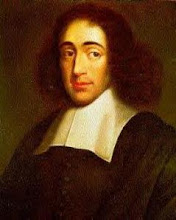
1.請解釋Spinoza為何選擇幾何學方法來呈現其理論。
2.請簡略說明Spinoza的causal determinism,並說明兩個主要的反對意見(miracle & free will)為何。

2010年9月27日 星期一
史賓諾沙授課大綱
國立中正大學哲學系教學大綱(學士班)
九十九學年度第一學期
課程名稱(中文) 史賓諾莎
課程名稱(英文) Spinoza
授 課 教 師 侯維之 修 別 □必修 □必選 專選
課 碼 1252928 學分數 2
教 學 目 標 本課程係延續九十八學年度經典教學課程:「笛卡爾(Descartes)」與「洛克(Locke)」。將教授Spinoza的Ethics。
奠基在對史賓諾沙就「上帝與心靈」的理論主軸上,期望能提供學生一個理解理性主義的窗口。
授 課 綱 要
Spinoza係理性主義第二位主要哲學家,影響他的所有哲學家中,最重要的就是Descartes。由於Ethics是一本以幾何學方式寫作的極細緻哲學作品,本課程僅擬專注於第一與第二部分:Part I On God(論上帝)與Part II On the Nature and Origin of the Mind(論心靈的本質與起源)。其理由有二:第一,哲學史經典的教授必須輔以大量的補充說明,有益於學生對哲學文獻有初步瞭解,貪多不會有所助益;第二,九十八學年度的「笛卡爾」課程,專注於Descartes的Meditations on First Philosophy,其中以懷疑論、人類心靈認知結構、與上帝存在三大議題為核心,而Spinoza對後二者議題(即本課程擬教學的Part I & Part II)有許多分析,對Descartes的觀點做出攻擊與修正,而且其對後二議題的立場,正足以解釋為何對Spinoza而言,懷疑論根本不成為問題。
課 程 進 度 1. 史賓諾沙《倫理學》介紹(史賓諾沙《倫理學》的哲學方法論)
2. 《倫理學》第一部 〈關於上帝〉(物質、性質與樣態)
3. 《倫理學》第一部 〈關於上帝〉(相同本質不可能具備兩種以上物質)
4. 《倫理學》第一部 〈關於上帝〉(物質是必然、永恆與無限的存在)
5. 《倫理學》第一部 〈關於上帝〉(除了上帝,沒有其他物質可被理解)
6. 《倫理學》第一部 〈關於上帝〉(上帝與事物)
7. 《倫理學》第一部 〈關於上帝〉(因果必然性,無限與有限樣態)
8. 《倫理學》第一部 〈關於上帝〉(決定論與必然論)
9. 《倫理學》第一部 〈關於上帝〉(神性自由與奇蹟)
10. 期中考試與報告
11. 《倫理學》第貳部 〈心靈的起源與本質〉(平行論)
12. 《倫理學》第貳部 〈心靈的起源與本質〉(心靈與軀體)
13. 《倫理學》第貳部 〈心靈的起源與本質〉(單元論與二元論)
14. 《倫理學》第貳部 〈心靈的起源與本質〉(觀念)
15. 《倫理學》第貳部 〈心靈的起源與本質〉(真理與適切性)
16. 《倫理學》第貳部 〈心靈的起源與本質〉(認識的不同方式)
17. 《倫理學》第貳部 〈心靈的起源與本質〉(自由與意志)18. 期末考
教 科 書 及
參 考 書 目 Textbook:
Spinoza, B. (2006) Ethics. Translated by Elwes, R. H. M.. BiblioBazaar.
參考書籍:
Cook, J. Thomas (2007) Spinoza’s Ethics: A Reader’s Guide. Continuum.
Nadler, Steven (2006) Spinoza’s Ethics: An Introduction. Cambridge.
評 量 方 式 期中考35%,期末考40%,作業15%,出席10%。
九十九學年度第一學期
課程名稱(中文) 史賓諾莎
課程名稱(英文) Spinoza
授 課 教 師 侯維之 修 別 □必修 □必選 專選
課 碼 1252928 學分數 2
教 學 目 標 本課程係延續九十八學年度經典教學課程:「笛卡爾(Descartes)」與「洛克(Locke)」。將教授Spinoza的Ethics。
奠基在對史賓諾沙就「上帝與心靈」的理論主軸上,期望能提供學生一個理解理性主義的窗口。
授 課 綱 要
Spinoza係理性主義第二位主要哲學家,影響他的所有哲學家中,最重要的就是Descartes。由於Ethics是一本以幾何學方式寫作的極細緻哲學作品,本課程僅擬專注於第一與第二部分:Part I On God(論上帝)與Part II On the Nature and Origin of the Mind(論心靈的本質與起源)。其理由有二:第一,哲學史經典的教授必須輔以大量的補充說明,有益於學生對哲學文獻有初步瞭解,貪多不會有所助益;第二,九十八學年度的「笛卡爾」課程,專注於Descartes的Meditations on First Philosophy,其中以懷疑論、人類心靈認知結構、與上帝存在三大議題為核心,而Spinoza對後二者議題(即本課程擬教學的Part I & Part II)有許多分析,對Descartes的觀點做出攻擊與修正,而且其對後二議題的立場,正足以解釋為何對Spinoza而言,懷疑論根本不成為問題。
課 程 進 度 1. 史賓諾沙《倫理學》介紹(史賓諾沙《倫理學》的哲學方法論)
2. 《倫理學》第一部 〈關於上帝〉(物質、性質與樣態)
3. 《倫理學》第一部 〈關於上帝〉(相同本質不可能具備兩種以上物質)
4. 《倫理學》第一部 〈關於上帝〉(物質是必然、永恆與無限的存在)
5. 《倫理學》第一部 〈關於上帝〉(除了上帝,沒有其他物質可被理解)
6. 《倫理學》第一部 〈關於上帝〉(上帝與事物)
7. 《倫理學》第一部 〈關於上帝〉(因果必然性,無限與有限樣態)
8. 《倫理學》第一部 〈關於上帝〉(決定論與必然論)
9. 《倫理學》第一部 〈關於上帝〉(神性自由與奇蹟)
10. 期中考試與報告
11. 《倫理學》第貳部 〈心靈的起源與本質〉(平行論)
12. 《倫理學》第貳部 〈心靈的起源與本質〉(心靈與軀體)
13. 《倫理學》第貳部 〈心靈的起源與本質〉(單元論與二元論)
14. 《倫理學》第貳部 〈心靈的起源與本質〉(觀念)
15. 《倫理學》第貳部 〈心靈的起源與本質〉(真理與適切性)
16. 《倫理學》第貳部 〈心靈的起源與本質〉(認識的不同方式)
17. 《倫理學》第貳部 〈心靈的起源與本質〉(自由與意志)18. 期末考
教 科 書 及
參 考 書 目 Textbook:
Spinoza, B. (2006) Ethics. Translated by Elwes, R. H. M.. BiblioBazaar.
參考書籍:
Cook, J. Thomas (2007) Spinoza’s Ethics: A Reader’s Guide. Continuum.
Nadler, Steven (2006) Spinoza’s Ethics: An Introduction. Cambridge.
評 量 方 式 期中考35%,期末考40%,作業15%,出席10%。
2010年5月11日 星期二
洛克與語言
弗列格是分析哲學之父,但洛克對語言的想法架構了一個理解分析學派在語言哲學上簡單清楚的背景。我們可以說弗列格語言哲學的開端在反對洛克的中心思想。洛克將他對語言的想法呈現在 An Essay concerning Human Understanding :
Man, though have great variety of thoughts, and such, from which others, as well as himself, might receive profit and delight; yet they are all within his breast, invisible, and hidden from ohters, nor can of themselves be made appear. The comfort and advantage of society not being to be had without communication of thoughts, it was necessary, that man should find out some external sensible signs, whereby those invisible ideas, which his thoughts are made up of, might be made known to others. For this purpose, nothing was so fit, either for plenty or quickness, as those articulate sounds, which with so much ease and variety he found himself able to make. Thus we may conceive how words, which were by nature so well adapted to that purpose, come to be made use of by men, as the signs of their ideas; not by any natural connexion, that there is between particular articulate sounds and certain ideas, for then there would be but one language amongst all men; but by a voluntary imposition, whereby such a word is made arbitrarily the mark of such an idea. The use then of words, is to be sensible marks of ideas; and the ideas they stand for, are their proper and immediate signification.
以下條列式呈現洛克對語言的概念架構:
(一) 語言的功能定義了語言的本質。
(二) 溝通是語言的(社會性)功能。
(三) 語言溝通在傳達個人的想法(thought)。洛克認為沒有溝通社會的安定繁榮便不在,人便回到霍布斯的自然狀態。
(四) 文字的代表語言所要傳達的想法的組成份子的意義(signify, mean)。
(五) 想法由觀念概念(idea)所構成。
(六) 人的觀念無法被他人所感知到。
(七) 文字與文字所代表的意義之間的連結關係是任意的。
(八) 文字本身本質上並不具有意義
Man, though have great variety of thoughts, and such, from which others, as well as himself, might receive profit and delight; yet they are all within his breast, invisible, and hidden from ohters, nor can of themselves be made appear. The comfort and advantage of society not being to be had without communication of thoughts, it was necessary, that man should find out some external sensible signs, whereby those invisible ideas, which his thoughts are made up of, might be made known to others. For this purpose, nothing was so fit, either for plenty or quickness, as those articulate sounds, which with so much ease and variety he found himself able to make. Thus we may conceive how words, which were by nature so well adapted to that purpose, come to be made use of by men, as the signs of their ideas; not by any natural connexion, that there is between particular articulate sounds and certain ideas, for then there would be but one language amongst all men; but by a voluntary imposition, whereby such a word is made arbitrarily the mark of such an idea. The use then of words, is to be sensible marks of ideas; and the ideas they stand for, are their proper and immediate signification.
以下條列式呈現洛克對語言的概念架構:
(一) 語言的功能定義了語言的本質。
(二) 溝通是語言的(社會性)功能。
(三) 語言溝通在傳達個人的想法(thought)。洛克認為沒有溝通社會的安定繁榮便不在,人便回到霍布斯的自然狀態。
(四) 文字的代表語言所要傳達的想法的組成份子的意義(signify, mean)。
(五) 想法由觀念概念(idea)所構成。
(六) 人的觀念無法被他人所感知到。
(七) 文字與文字所代表的意義之間的連結關係是任意的。
(八) 文字本身本質上並不具有意義
洛克教學大綱
教 學 目 標 本課程教授LockeAn Essay Concerning Human Understanding(人類理解研究)的Book I及Book II的一部分。根據當代分析哲學,帶領學生研讀瞭解其中重要的概念與論證。
授 課 綱 要
針對Descartes「天生觀念」(innate idea),由經驗主義者Locke在An Essay Concerning Human Understanding(人類理解研究)Book I與Book II中,所提出的討論與批評。並進一步分析Locke的論證是否成立。
課 程 進 度 第一週:洛克概述與Book I第一章「No Innate Speculative Principles」。
第二週:續Book I第一章。
第三週:Book I第二章「No Innate Practical Principles」。
第四週:續Book I第二章。
第五週:Book I第三章「Other Considerations Concerning Innate Principles, Both Speculative and Practical」。
第六週:續Book I第三章與Book I 總結討論。
第七週:Book II第一章「Of Ideas in General, and Their Original」。
第八週:續Book II第一章。
第九週:期中考。
第十週:Book II第二章~第四章。
第十一週:Book II第五章~第八章。
第十二週:Book II第九章~第十章。
第十三週:Book II第十一章~第十三章。
第十四週:Book II第十四章~第十六章。
第十五週:續Book II第十七章。
第十六週:Book II第十八章~第二十一章。
第十七週:Book II總結討論。
第十八週:期末考。
教 科 書 及
參 考 書 目 Text Book:
Fraser A. C., 1894, Locke’s Essay Concerning Human Understanding, Oxford University Press.
參考書籍:
Lowe E. J., 1995, Routledge Philosophy Guide Book to Locke on Human Understanding, Routledge.
評 量 方 式 期中考40%,期末考50%,出席10%。
授 課 綱 要
針對Descartes「天生觀念」(innate idea),由經驗主義者Locke在An Essay Concerning Human Understanding(人類理解研究)Book I與Book II中,所提出的討論與批評。並進一步分析Locke的論證是否成立。
課 程 進 度 第一週:洛克概述與Book I第一章「No Innate Speculative Principles」。
第二週:續Book I第一章。
第三週:Book I第二章「No Innate Practical Principles」。
第四週:續Book I第二章。
第五週:Book I第三章「Other Considerations Concerning Innate Principles, Both Speculative and Practical」。
第六週:續Book I第三章與Book I 總結討論。
第七週:Book II第一章「Of Ideas in General, and Their Original」。
第八週:續Book II第一章。
第九週:期中考。
第十週:Book II第二章~第四章。
第十一週:Book II第五章~第八章。
第十二週:Book II第九章~第十章。
第十三週:Book II第十一章~第十三章。
第十四週:Book II第十四章~第十六章。
第十五週:續Book II第十七章。
第十六週:Book II第十八章~第二十一章。
第十七週:Book II總結討論。
第十八週:期末考。
教 科 書 及
參 考 書 目 Text Book:
Fraser A. C., 1894, Locke’s Essay Concerning Human Understanding, Oxford University Press.
參考書籍:
Lowe E. J., 1995, Routledge Philosophy Guide Book to Locke on Human Understanding, Routledge.
評 量 方 式 期中考40%,期末考50%,出席10%。
2010年1月5日 星期二
Meditation III homework
作業繳交期限為一月十二號24:00之前,請大家將題目列印寫上答案,請交至文學院四樓助教胡映群信箱。
Exercise 3.1
Arrange the following concepts in the order in which Descartes presents them in the first half of Meditation III
a. He has discovered no evidence providing that his sensory ideas are accurate copies of objects.
b. He must prove that God exists and that God is no deciever before he can discover other certitudes.
c. He categorizes his thoughts into violitions, emotions, and judgments.
d. A clear and distinct grasp of something is required to know a thing for certain.
e. The light of nature is different from natural impluse.
f. His ideas are either innate, acquired, or produced by him.
Exercise 3.2
1. Paraphrase the first argument in paragraph 8 ("For the moment, the central question..."). Because Therefore,
2. Paraphrase the first argument in paragraph 9 ("I will now see whether these reasons..."). Because Therefore,
3. Paraphrase the first argument in paragraph 8 ("Next, while my sensory ideas may not..."). Because Therefore,
4. Paraphrase the first argument in paragraph 8 ("Finally, even if some of my ideas..."). Because Therefore,
5. Now look at paragraphs 8, 9, 10, and 11. Paragraph(s) refute(s) arguments in paragraph(s)
Exercise 3.3
Underline the conclusion, the "therefore" statement, in each of the following arguments.
1. I think I exist. I can be absolutely certain I exist. I must exist in order to think I exist.
2. I cannot tell or certain that external objects exist. I cannot tell if my ideas are accurate copies of external objects, then I cannot know for certain that external objects exist.
3. God could be deceiving me. God is all-powerful.
4. It is not possible that anything I've grasped clearly and distinctly could be false. In the future, I can use it as a general rule that anything I grasp clearly and distinctly is true.
5. I need to prove that God is no deciever. God might be deceiving me. If God is deceiving me, then I can't know anything for certain.
6. I should be careful when I make judgments about my ideas being copies of external objects. I can make errors when I judge that my ideas are copies of external objects.
EXercise 3.4
Omitting argument 1, arrange the arguments in 3.3 in the order in which they occur in Meditation III, and give the paragraph number of each argument.
Exercise 3.1
Arrange the following concepts in the order in which Descartes presents them in the first half of Meditation III
a. He has discovered no evidence providing that his sensory ideas are accurate copies of objects.
b. He must prove that God exists and that God is no deciever before he can discover other certitudes.
c. He categorizes his thoughts into violitions, emotions, and judgments.
d. A clear and distinct grasp of something is required to know a thing for certain.
e. The light of nature is different from natural impluse.
f. His ideas are either innate, acquired, or produced by him.
Exercise 3.2
1. Paraphrase the first argument in paragraph 8 ("For the moment, the central question..."). Because Therefore,
2. Paraphrase the first argument in paragraph 9 ("I will now see whether these reasons..."). Because Therefore,
3. Paraphrase the first argument in paragraph 8 ("Next, while my sensory ideas may not..."). Because Therefore,
4. Paraphrase the first argument in paragraph 8 ("Finally, even if some of my ideas..."). Because Therefore,
5. Now look at paragraphs 8, 9, 10, and 11. Paragraph(s) refute(s) arguments in paragraph(s)
Exercise 3.3
Underline the conclusion, the "therefore" statement, in each of the following arguments.
1. I think I exist. I can be absolutely certain I exist. I must exist in order to think I exist.
2. I cannot tell or certain that external objects exist. I cannot tell if my ideas are accurate copies of external objects, then I cannot know for certain that external objects exist.
3. God could be deceiving me. God is all-powerful.
4. It is not possible that anything I've grasped clearly and distinctly could be false. In the future, I can use it as a general rule that anything I grasp clearly and distinctly is true.
5. I need to prove that God is no deciever. God might be deceiving me. If God is deceiving me, then I can't know anything for certain.
6. I should be careful when I make judgments about my ideas being copies of external objects. I can make errors when I judge that my ideas are copies of external objects.
EXercise 3.4
Omitting argument 1, arrange the arguments in 3.3 in the order in which they occur in Meditation III, and give the paragraph number of each argument.
2009年11月5日 星期四
Meditation II Homework
作業繳交期限為十一月十八號24:00之前 請交至文學院四樓助教胡映群信箱
Exercise 2.1
Label each of the following statements consistent(C) or inconsistent(I) with idea Descartes presents in the first two paragraphs of Meditation II.
1. There is a way to defeat the evil demon.
2. The doubts from Meditation I remain.
3. The only certainty may be that there us no certainty.
4. Concepts that can be partially doubted should be treated different from concepts that can be entirely doubted.
5. Descartes, unlike Archimedes, will need to find more than one indubitalbe truth.
Exercise 2.2
Label each of the following statements consistent(C) or inconsistent(I) with idea Descartes presents in the paragraphs 3 of Meditation II.
1. If Descartes denies that he has senses and a body, then he can't prove that he exists.
2. Descartes proves that God exists.
3. The deceiver could not deceive Descartes into believing he, Descartes, does not exist.
4. Even if there is no physical world, it does not follow that Descartes' minf does not exist.
5. Descartes prove that he exist.
Exercise 2.3
Number the following ideas in the order in which Descartes introduces them in Meditation II.
a. He examines the wax with his sense.
b. He knows for certain that he exists.
c. He notes that his mind, rather than his senses, understands the wax clearly.
d. He assumes that he knows nothing for certain.
e. He realizes that his imagination cannot make an accurate mental picture of all the possible shapes that the wax could take.
f. He is a thinking thing.
Exercise 2.4
One benefit studying Descartes is learning how to reason more effectively. He often uses example to make a point. Briefly answer the questions that follow each of Descartes' example.
1. "Archimedes required only one fixed and immovable point to more the whole earth from its place, and I too can hope for great things if I can find even one small thing that is certain and unshakable."
a. Archimedes is being compared to?
b. "One fixed and immovable point" is being compared to ?
c. Moving "the whole earth from its place" is being compared to?
d. The point of this analogy is?
2."Let's consider hte things commonly taken to be the most distinctly comprehended: physical objects that we see and touch. Let's not consider physical objects in general, since general conceptions are very often confused. Rather, let's consider one particular object. Take, for example, this piece of wax."
a. "distinctly comprehended" means?
b. An example of a "general conception" might be?
c. The goal in examining the wax is to find out about what?
d. The wax is an example of what?
3."But, if I happen to look out my window and see man walking in the street, I naturally say that I see the men just as I say that I see the wax. What do I really see, however, but hats and coats that could be covering robots? I judge that there are men. Thus I comprehend with my judgement, which is in my mind, obejcts that I once believed myself to see with my eyes."
a. The error Descartes believes he makes when he says he "see" the men and the wax is?
b. What is the purpose of mentioning "robot"?
c. What general point is Descartes making about his senses?
d. What general point is Descartes making about judgment?
e. What causes errors of the type described in this example?
f. What does the last sentence conclude?
g. What evidence is offered for the conclusion in the last sentence?
Exercise 2.1
Label each of the following statements consistent(C) or inconsistent(I) with idea Descartes presents in the first two paragraphs of Meditation II.
1. There is a way to defeat the evil demon.
2. The doubts from Meditation I remain.
3. The only certainty may be that there us no certainty.
4. Concepts that can be partially doubted should be treated different from concepts that can be entirely doubted.
5. Descartes, unlike Archimedes, will need to find more than one indubitalbe truth.
Exercise 2.2
Label each of the following statements consistent(C) or inconsistent(I) with idea Descartes presents in the paragraphs 3 of Meditation II.
1. If Descartes denies that he has senses and a body, then he can't prove that he exists.
2. Descartes proves that God exists.
3. The deceiver could not deceive Descartes into believing he, Descartes, does not exist.
4. Even if there is no physical world, it does not follow that Descartes' minf does not exist.
5. Descartes prove that he exist.
Exercise 2.3
Number the following ideas in the order in which Descartes introduces them in Meditation II.
a. He examines the wax with his sense.
b. He knows for certain that he exists.
c. He notes that his mind, rather than his senses, understands the wax clearly.
d. He assumes that he knows nothing for certain.
e. He realizes that his imagination cannot make an accurate mental picture of all the possible shapes that the wax could take.
f. He is a thinking thing.
Exercise 2.4
One benefit studying Descartes is learning how to reason more effectively. He often uses example to make a point. Briefly answer the questions that follow each of Descartes' example.
1. "Archimedes required only one fixed and immovable point to more the whole earth from its place, and I too can hope for great things if I can find even one small thing that is certain and unshakable."
a. Archimedes is being compared to?
b. "One fixed and immovable point" is being compared to ?
c. Moving "the whole earth from its place" is being compared to?
d. The point of this analogy is?
2."Let's consider hte things commonly taken to be the most distinctly comprehended: physical objects that we see and touch. Let's not consider physical objects in general, since general conceptions are very often confused. Rather, let's consider one particular object. Take, for example, this piece of wax."
a. "distinctly comprehended" means?
b. An example of a "general conception" might be?
c. The goal in examining the wax is to find out about what?
d. The wax is an example of what?
3."But, if I happen to look out my window and see man walking in the street, I naturally say that I see the men just as I say that I see the wax. What do I really see, however, but hats and coats that could be covering robots? I judge that there are men. Thus I comprehend with my judgement, which is in my mind, obejcts that I once believed myself to see with my eyes."
a. The error Descartes believes he makes when he says he "see" the men and the wax is?
b. What is the purpose of mentioning "robot"?
c. What general point is Descartes making about his senses?
d. What general point is Descartes making about judgment?
e. What causes errors of the type described in this example?
f. What does the last sentence conclude?
g. What evidence is offered for the conclusion in the last sentence?
2009年10月7日 星期三
Meditation I Homework
Exercise 1.1
1. He must show each of his beliefs to be false.
2. It is not possible to achieve certainty about anything.
3. His beliefs have a doubtful, shaky foundation.
4. He should treat beliefs that are slightly doubtful the same as beliefs that are completely doubtful.
5. He will begin by attacking his "foundational" beleifs.
6. All knowledge appears to come through the senses.
Exercise 1.2
a. He might be like a madman.
b. He needs to attack the foundations of his beleifs.
c. He imagines he is dreaming.
d. He asserts that all he has learned has come from his senses.
e. He imagines an evil demon who is fooling him all the time.
f. He does not beleive he can tell dreaming from waking.
g. He remembers that his senses occasionally deceive him about objects they cannot perceive clearly.
h. He believes God might be deceiving him about even obvious concepts, such as simple mathemtical truths.
i. Whether he is asleep or awake, he can know simple mathematical truths.
j. His dreams must be copies of something real.
1. He must show each of his beliefs to be false.
2. It is not possible to achieve certainty about anything.
3. His beliefs have a doubtful, shaky foundation.
4. He should treat beliefs that are slightly doubtful the same as beliefs that are completely doubtful.
5. He will begin by attacking his "foundational" beleifs.
6. All knowledge appears to come through the senses.
Exercise 1.2
a. He might be like a madman.
b. He needs to attack the foundations of his beleifs.
c. He imagines he is dreaming.
d. He asserts that all he has learned has come from his senses.
e. He imagines an evil demon who is fooling him all the time.
f. He does not beleive he can tell dreaming from waking.
g. He remembers that his senses occasionally deceive him about objects they cannot perceive clearly.
h. He believes God might be deceiving him about even obvious concepts, such as simple mathemtical truths.
i. Whether he is asleep or awake, he can know simple mathematical truths.
j. His dreams must be copies of something real.
訂閱:
文章 (Atom)